PANAMA CANAL TO FURTHER REDUCE DRAFT LIMIT FOR NEOPANAMAX VESSELS
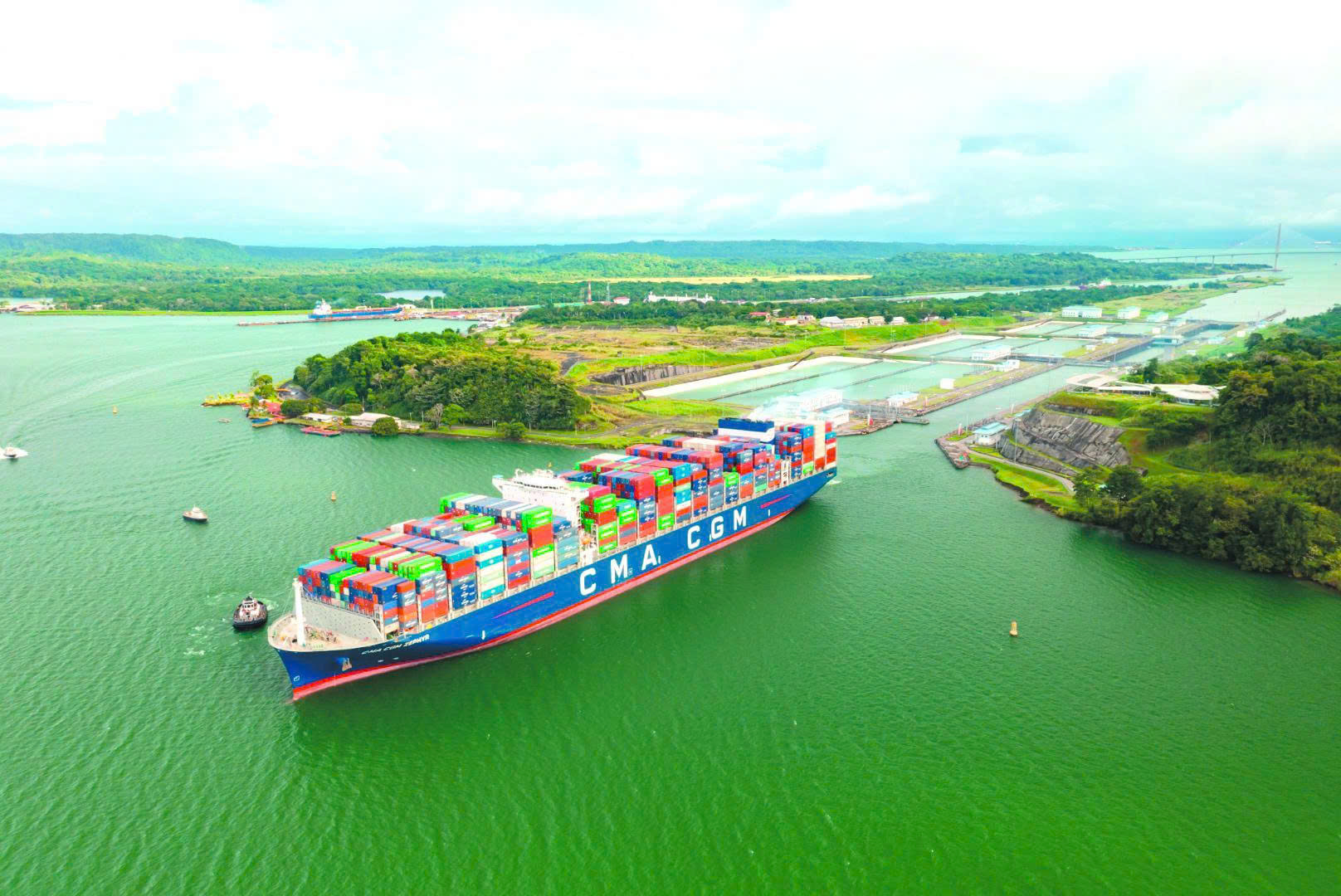
The Panama Canal will further reduce the maximum allowable draft for Neopanamax vessels from late August 2026 as water levels in Gatun Lake continue to decline.
According to the Fulbright Economics Teaching Program on “Local and Regional Development”, the term “cluster” is “the geographical concentration of businesses, suppliers, and related businesses.” as well as companies in related industries and supporting institutions (e.g. universities, standards bureaus, trade associations, etc.) compete with each other”.

They also provide a criterion of competitiveness (competitive capacity) of each company/industry that depends a lot on the "ecosystem" or cluster - in which the company and industry exist. Clusters are linked by reciprocity and are resonated by positive spillovers.
Also according to Fulbright, clustering is an important factor to improve competitiveness. Clusters promote productivity and efficiency, because clusters provide access to specialized information, services and materials; Speed up; reduce coordination and transaction costs; Increased ability to spread good practice; Increasing competition, In terms of promoting innovation, that is, the cluster industry increases its ability to identify opportunities for technological innovation; Reducing costs and risks of testing new technologies, In terms of promoting commercialization, it is creating opportunities to develop new products and/or new businesses; Reduce costs, speed up commercialization. These are also the values Logistics brings.
In fact, although the process of restructuring economic sectors in Vietnam has achieved certain results, there are still limitations such as the slow process of restructuring in some sectors, the results of which have not yet been achieved. have not yet met the objectives and requirements; industry growth has not reached the set target and is not stable...
The results are shown in the promotion of linkages by sectors, regions and economic clusters; The industry structure is implemented in a positive direction, increasing the contribution proportion of the processing industry, manufacturing, markets, diversified export products... However, the upgrading and application of the achievements of innovative technology is not high, lack of initiative; A dynamic economy has not yet been formed, there has been no significant change in the restructuring of economic sectors; Regarding exports, few new products and new industries are formed.

Among the shortcomings, especially, the links with developed countries and economic clusters are not strong enough. Labor productivity has not been significantly improved. The independence and resilience of many industries is still low, the market is not diversified, there is a lack of systematic linkage, heavily depends on fluctuations in world market supply and demand, price fluctuations...
According to the economic experts of the cluster, the structure of the industry in the direction of increasing connectivity and clustering is still limited; Industrial parks and economic zones mainly develop multi-sectors, core actors for cluster development such as large-scale projects and strategic foreign investment partners have not yet been formed. linkages between enterprises in industrial parks and economic zones in production and supply of products and services have not yet been developed. In addition, the current situation of spatial distribution of industries has not yet fully exploited the advantages and geographical position and potential of localities; Industry linkage chains have not yet been formed.
The planning of industrial parks and industrial clusters has not really been associated with specialized industrial clusters, and has not built substantively specialized industrial complexes in industrial concentration zones; has not yet created an ecosystem consisting of end product manufacturing enterprises, supply enterprises, component suppliers, consulting service providers, finance, science and technology.
In a report conducted by the Central Economic Commission and the World Bank, the leading provinces in terms of employment in the transport and logistics cluster include Ho Chi Minh City. Ho Chi Minh City, Hanoi, Hai Phong, Binh Duong and Dong Nai. Among them, Binh Duong and Dong Nai have a weak degree of cluster specialization (LQ<1).
The localities participating in the transport and logistics cluster are distributed throughout the country, of which the provinces in the group of 10% highly specialized have Ho Chi Minh City. Ho Chi Minh City, Hanoi, Hai Phong, Da Nang, Binh Dinh and provinces in the highly specialized 25% group, including Quang Ninh, Ba Ria - Vung Tau... Thus, the transport and logistics cluster is still one “bottlenecks” make the growth unstable.
In the current new conditions, according to experts, in order to strengthen the economic linkage by sectors, improve the efficiency of clusters, it is necessary to regulate the flow of economic resources appropriately and effectively. Selection and pilot development of a number of cluster models in the economic restructuring process. Reorganization of production along the value chain, .. to innovate, first of all, it is necessary to specify what is the cause of the loose economic linkage by industry and region. Is the laxity in the mindset of "sands", "strong, everyone does" or due to planning and investment resources?
.jpeg) In 2022, one of the "marks" when the Politburo considers and promulgates new resolutions on socio-economic development, national defense and security assurance in all six socio-economic regions of the country. country. The Government then issued an Action Plan to implement these resolutions.
In 2022, one of the "marks" when the Politburo considers and promulgates new resolutions on socio-economic development, national defense and security assurance in all six socio-economic regions of the country. country. The Government then issued an Action Plan to implement these resolutions.
In fact, for a long time, Vietnam has been interested in regional planning, not only provinces, but also districts have industrial zone planning... However, the capacity to implement economic clusters is only limited to the idea. ideas, planning, not succeeding in practice. The reason is that the new "economic cluster" is the result of voluntarism, partly expressing the "syndrome" mentality, which has not been designed with the "value chain" thinking, following the movement of the economy. market.
In the current new conditions, in order to strengthen the economic linkage by sector, region and improve the resilience of the economy, it is necessary to regulate the flow of economic resources appropriately and effectively. Selection and pilot development of a number of cluster models in the economic restructuring process. Search and expand markets for economic cluster development... Reorganize production along value chains, develop clusters of linkages - processing - consuming agricultural products in localities and regions has a large output of agricultural products... These are also the contents of the current economic restructuring process.
The Panama Canal will further reduce the maximum allowable draft for Neopanamax vessels from late August 2026 as water levels in Gatun Lake continue to decline.
In modern logistics, delays are no longer viewed as mere inconveniences. They can result in significant financial losses, including reduced revenue, dissatisfied customers, increased warehousing costs, disrupted production schedules, and damaged business reputation
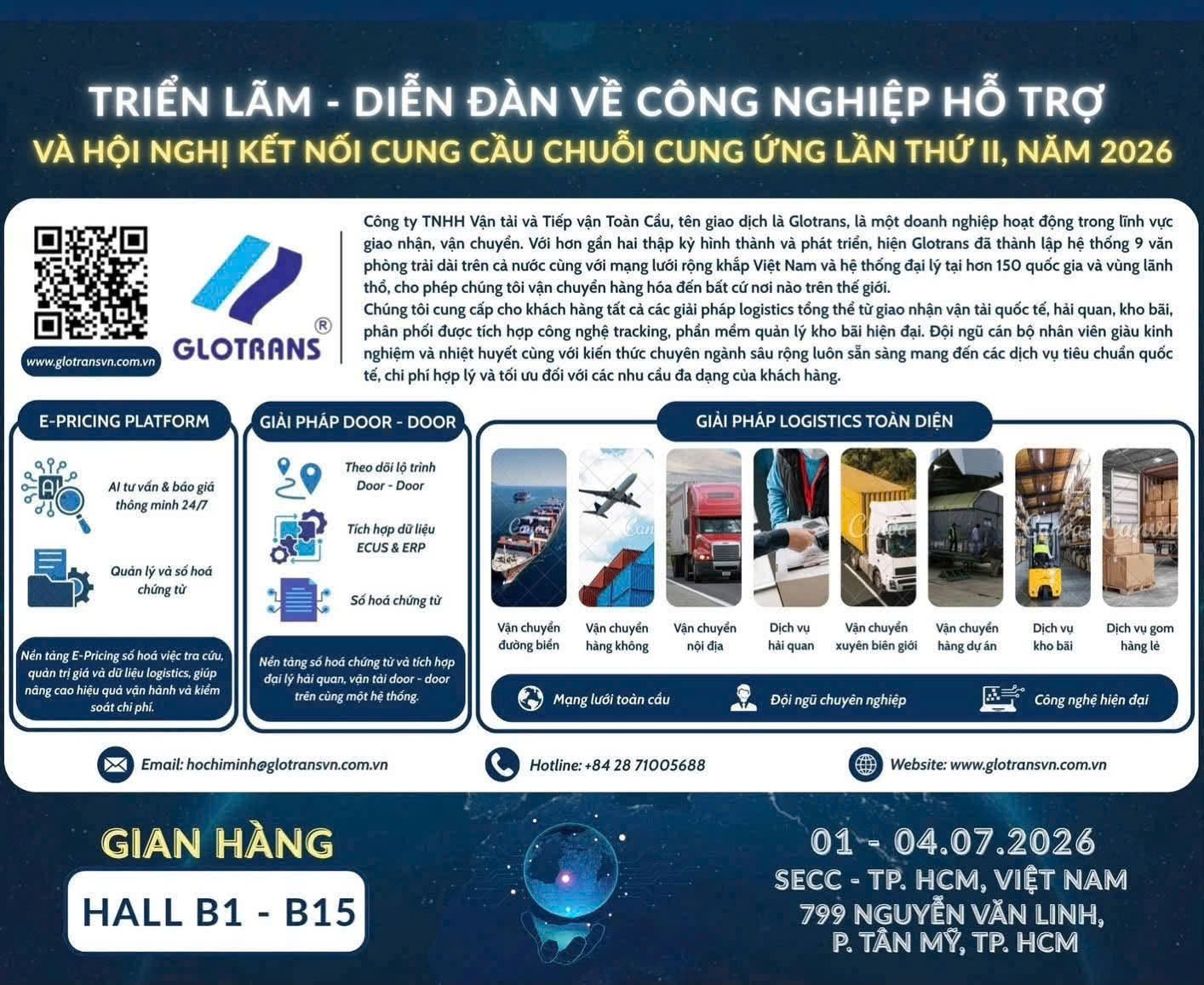
From July 1–4, 2026, Glotrans is participating in MTA Vietnam 2026, one of Vietnam's leading international exhibitions for precision engineering, manufacturing, and supporting industries, held at the Saigon Exhibition and Convention Center (SECC), Ho Chi Minh City.
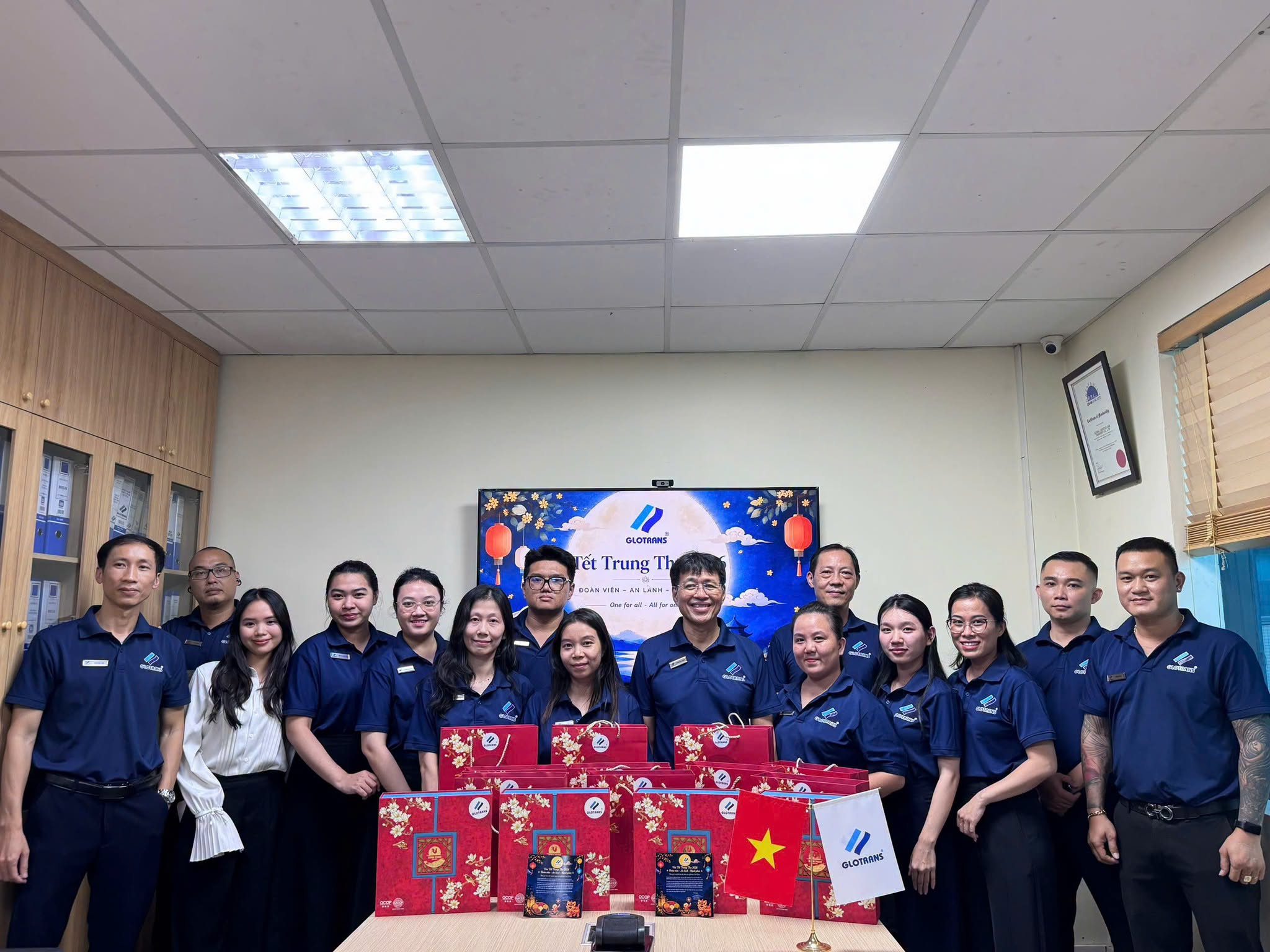
The Mid-Autumn Festival is not only a time for family reunions, but also a special occasion to share love, send warm wishes, and enjoy meaningful moments with our beloved colleagues.
Over the past few days, GLOTRANS’s General Director has been traveling between offices, from Da Nang to Quy Nhon, to personally attend meetings reviewing the business performance of the first six months of the year, assess each office’s operations, and work with the teams to set goals for the next stage.
GLOTRANS would like to inform our Valued Customers and Partners of our holiday schedule for Vietnam’s National Day (2 September 2026) as follows:
The shipment of food additives was transported in container No. FCIU3301688 (20’), under B/L MPRSMUM1806, on the voyage from Nhavasheva Port (India) to Dinh Vu Port (Hai Phong, Vietnam) on 29/04/2017.
Company T (Plaintiff – the Insured) entered into an insurance contract with Company B (Defendant – the Insurer). After the insured event occurred, the Insurer alleged that the Insured had violated its obligation to prevent and mitigate losses. The Arbitral Tribunal acknowledged that such an obligation exists but concluded that the Insured did not breach it.
Under the insurance contract, the premium was to be paid in three installments, and in all three, the insured party was late in payment. When a dispute arose, the insurer (Defendant) argued that the insurance contract had terminated before the insured event occurred due to the late premium payment and therefore refused to make an insurance payout. However, the Arbitral Tribunal held a contrary view.